Top Menu

Wedding Traditions

Share your wedding traditions

…Something old, something new, something borrowed, something blue … Ever wonder where wedding traditions come from and why they are wedding traditions? Unsure which wedding tradition to incorporate into your wedding? Let these interesting wedding tradition facts help you decide which wedding traditions to include in your wedding. Does your family have an interesting wedding tradition? Share your wedding tradition.

Aug
25
2009
by Leigh Morrisett

In most all weddings, at the end of the ceremony the bride and groom exchange a kiss. The wedding kiss is one of the longest wedding traditions to still be in use today. As with most traditions, they all stem from either a religious nature or more of a business-like nature. Kissing at the end of the wedding ceremony garners history from both the religious aspect, as well as, contractual one.

Roman history shows that a couple was betrothed if they kissed passionately in front of a large group including family. In old world Christian culture, they viewed a wedding kiss as a symbol of the scripture – two souls becoming one flesh. However we can note that in Roman society, a kiss was used, as we do today, as a gesture of a commitment; much like we use a handshake at the end of a business deal. In fact during Roman times, a kiss given to another party was used to signify a legal contract. Yes, even for just a everyday business deal a kiss sealed the deal. So, a groom and a bride would seal the deal (marriage contract) with a kiss. Romans had three types of kisses; a kiss on the cheek, a kiss on the lips and then a deeper more passionate kiss. I believe the latter was the wedding kiss.

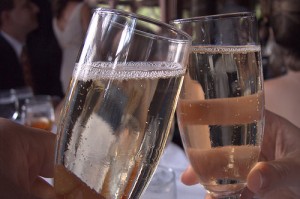
Going back to the religious side, some early Christian’s believed clinking glass at the wedding or wedding reception would scare off the devil. After this was done, the couple would exchange a kiss to show joy and happiness.  Whether was done for religious reasons, contractual, reason the wedding day kiss is now a tradition that is sweet and endearing.

Aug
14
2009
by Jamie Jamison Adams

Yesterday, I received a lovely email from Thu Vu owner of My Little Work Shop.  She and Brynn were having a conversation on Facebook about Wedding and Party Network and how we discuss wedding traditions among other things on the Celebration Advisor.  The conversation turned to multi-cultural weddings of which Thu Vu knows quite a bit about, since she is planning one herself.  Here is what she shared with us about Vietnamese/Chinese Wedding Traditions.

I am here to talk about the Vietnamese and Chinese wedding tradition. I am pretty sure that in America and in Canada the wedding would have a ceremony and reception. Vietnamese/Chinese tradition is different from the American's and Canadian's ceremony, which takes place at the church or somewhere else but with a priest, friends and families when you exchange your vows.

In the Vietnamese/Chinese tradition is that we have the groom's side of the family members and friends to carry lacquered, round boxes; betrothal presents to the bride's house. Only the males on his side would stand behind/beside one another (depends on what you're carrying)to carry the presents to the bride's house. You have to be unmarried and the guys that the groom may pick could be his own brothers, ushers, best man etc…

These presents are to be in your choice of betel leaves, areca nuts, wines, jewelries, fruits, cake tea, tea set, whole pig etc…you are to carry about 10-12 of these presents to her house. You may have double of the same items if you wish. The gifts are to be covered by red cloths.

The bride's side of the family members and friends are suppose to be waiting by the door. Their jobs are to collect the presents. The groom then would ask for the bride's hand in marriage.

The groom then are to place the jewelries on her. Such as placing the earrings in her ear and the ring on her finger. The parents/gram parents are to be seated on chairs, you are to take the tea while you are in front of them on your knees. You basically bow and give them tea to have a sip.

This tea giving is a very respectful thing to do when joining two families in one. I thank you for taking the time to read this. I will soon put some pictures up of my engagement. I am doing the presents giving and not the tea ceremony. The tea ceremony is used at the wedding. I attached some pictures for you, so enjoy!

What a beautiful tradition, both in color and in sentiment.  Thank you for sharing such a wonderful wedding tradition with us. The photos are amazing.

Jul
28
2009
by Leigh Morrisett

I know, you read the title and said, cake pulls? I thought southerners were in to truck pulls…Never heard of a cake pull, and what does it have to do with wedding traditions?  A cake pull actually comes to us from our Victorian ancestors and as it turns out that Southerners are the ones who usually carry on this tradition.

What Is A Cake PULL

A cake pull is where the wedding cake has silk ribbons with charms slipped under the last layer.  These charms are made of sterling silver. Traditionally the charms are a ring, a heart, a star, hot air balloon, and anchor, to name a few. These charms have symbolic meaning.  The charms are placed under the last layers and are made to easily pull out by the brides maids as the tradition goes.  If a bride’s maid pulled out the ring, this symbolizes a wedding in the future. A star symbolizes wishes come true while a heart means a new love.

Sad but true a friend of a friend decided she was going to do the cake pull tradition at her wedding.  Except she baked the cake pulls into her cake. (Not a good idea, it ruins the cake when you pull the charms out.) If you decided to do this tradition, please make sure you have the bakery put the charms under the last layer and I also recommend that they use some parchment paper between the cake and the cake pulls, this makes it easier to pull them out.

Modern Day Cake Pulls

I suggest using the cake pull tradition but not with the wedding cake.  Imagine the horror of someone pulling the cake pull a bit to roughly and your whole wedding cake falling to the floor.  My suggestion is to do it as a separate cake for the bridesmaids, maybe at the bridal shower, or as a novel way to give the bridesmaids their bridesmaid’s gifts.  You can personalize them by choosing charms that means something to you and your bridesmaids.

I also like the idea that the Bride's Mother and the Groom's Mother have their own Mother's cake and this is where the cake pulls are.  This idea works well for small weddings. The mothers buy the charms and have the cake made. As the guests come into the reception hall each guest is asked to do a cake pull.  Each guest then gives the bride the charms for her to put on a bracelet that the fathers have bought and given to the bride.

Don't you agree that the tradition of cake pulls needs to make a come back, of course with a modern twist?

Jun
24
2009
by Leigh Morrisett

Captive Honeymoon!

This past weekend I attended a lovely morning wedding.  The ceremony time was chosen, not because morning light is so beautiful, but so the couple could catch an early flight to their honeymoon destination.  This made me wonder, where did the honeymoon tradition start?

Weddings have taken place in some form or another since the beginning of history. However, I wondered if early honeymoons were like they are now.  I doubt that past generations could afford to travel as we do now for our honeymoons.  So I began my own journey to find the answer to "where did the honeymoon tradition come from?"

In my quest, I found it had to do with the “capture of the bride" era. This era is known as marriage by capture and in some third world countries still takes place.  Historically "marriage by capture" is roughly attributed to the 15th century and considered the beginning of the honeymoon concept.  However, honeymoons may have occurred much early.

The honeymoon took place after the man captured or took his "bride". The "groom" would steal the "bride" away from her family and all others for a "moon's time" which is roughly 30 days.  Hopefully during the thirty days, the bride would conceive a child.  Forcing her family to “consent” to a marriage.

Why all the drama? For one, the groom was usually from another tribe and not likely to be given consented to marry the women.  Kidnapping was a way to force the issue and the thirty days gave the "groom" time to persuade the family.

Why Honeymoon?

During the 30 days of "marriage by capture", the groom would give his captured "bride" a drink of mead know as metheglin.  Mead is a fermented drink of herbs and honey. This drink made from honey and given to the bride by her groom during a "moons time" gives us the word of honeymoon.

Down through the ages as we have moved from a tribal to a civil society , the honeymoon tradition has given way to a more romantic sentiment.  Now the groom and bride plan a trip away from family and friends. Their honeymoon destination allows them to enjoy their wedded bliss.

While at a wedding Saturday, my husband asked me why the bride stands on the left. Traditionally, you will see the bride stand to the groom's left during most American & Western wedding ceremonies. My reply was "it's a tradition."  Then I stated wondering where this wedding tradition came from so I did a little research on the subject.

History points to the "marriage by capture" era as initial reason for this wedding tradition.  Then the middle ages seem to have played at large part in the solidifying the tradition.  In the early age of civilization, people lived in tribes.  Often the men in these tribes would steal women from the other tribes and force them to marry. The stealing tribesmen would fight off the "bride's" tribesmen with their right hands whilst holding the "bride" with their left.  In the middle ages a knight wore his sword on his left side to be able to draw it with his right hand.  If he needed to draw his sword during the wedding ceremony, the knight would not want to draw his sword toward his bride but away from her.  Hence, the bride had to be to his left.

Biblically speaking we could attribute it simply to the idea that women and men were separated in the early churches.  The woman sat on the left side of the church and the men on the right. Some say that scripture could be interpreted that the bride should be on the left.

It seems that this wedding tradition has been claimed by many with a variety of reasons.  It may have begun the moment men and women sought a commitment to each and continues on today many, many millions of wedding ceremonies later.

Apr
28
2009
by Leigh Morrisett

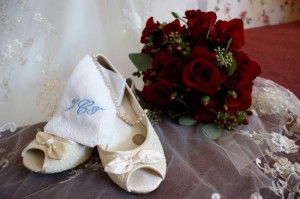
Most brides today carry flowers because they are beautiful and it gives the nervous bride something to do with her hands. However, the carrying of flowers goes back as far as the beginning of marriage.  Rooted in superstition, it was thought bridal bouquets consisting of odoriferous herbs and garlands worn or carried would ward off demons and evil spirits. Variations of this superstition are found in many cultures throughout the world.

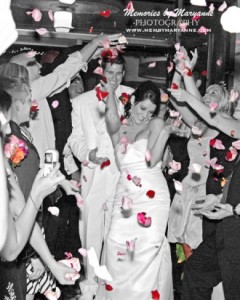
In India the bride and groom are sprinkled with flower petals to ward of evil. It is said that a Roman bride carried herbs such as rosemary in her veil to ward off evil spirits. In fact, the modern tradition of carrying flowers and herbs in the bridal bouquet stems from this Roman practice. With many cultures sharing their wedding traditions over the centuries, the primitive superstition of smelly garlands went by the wayside. Brides began to use flowers as a way to symbolize emotion, virtue of love and marriage transforming the tradition.

Flowers such as roses became symbols of love for western weddings. Herbs and flowers were mixed together as a symbolic gesture. Over the years, wedding traditions have been manipulated blending old tradition with contemporary ideals. Old Greek wedding traditions used ivy and ribbons; weaving them into crowns for the bride and groom to symbolize unity. This tradition of greenery and ribbons has been incorporated in many modern wedding bouquets. In fact, it is commonplace to see bridal bouquets with greenery and ribbons intertwined in the flowers.

Although wedding flowers are a long standing tradition, the use flowers has become more of a tradition of elegance than one of warding off demons. Thankfully the tradition changed and flowers are now used to decorate the wedding. The bride can now carry a bouquet for beauty and not as protection from evil spirits.

Mar
24
2009
by Leigh Morrisett

Many wedding traditions stem from very old customs, religions or superstitions, while others evolve through necessity. Some are the result of the love we have for something or someone.  A new "old" wedding tradition that is rising in popularity comes from the love we have for our pets.

Who was the first to include a pet in their wedding and when did it happen? We can't be 100% sure. Most likely it occurred around 2100B.C. in the Bedouins tribes of Egypt who adored their Salukis. A resurgence of this tradition is occurring among contemporary couples all over the world. These couples are choosing to make their furry companions a part of the ceremony.

What is causing the resurgence of this doggie wedding tradition? The rising age of first times brides and grooms seems to be the contributing factor. After all, their pets were their constant companions before the love of their life enter their world.  That's not to say that younger couples haven't included pets in their weddings.  There have been weddings with all different types of pets from snakes to ferrets and from dogs to cats. In all cases, you can be certain that a couple who chooses to have a pet in their ceremony does this out of love for their non-human companion.

Of course, dogs are the most common wedding attendees.  They have even been members of the wedding party. Dogs have served as ring bearers, flower carriers, and even the bride or groom's "dog of honor" or "best" dog.  You can even find tuxedos to fit your pet to carry this tradition to the full extent.

This "old" new tradition is one that is gaining in popularity. So, don't be surprised if at the next wedding you attend you see a furry friend escorting the Bride to the alter.

Feb
24
2009
by Leigh Morrisett

Where Did The Tradition Of Tying Shoes To The Bridal Vehicle Come From?

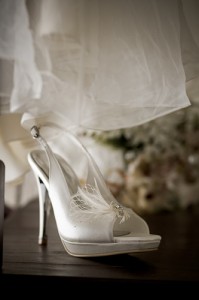
Some people believe the tradition stems from the Egyptians.  It is said that Egyptians once exchanged sandals after exchanging goods. As a result, it is thought that the father would give the groom his daughter's sandals (bride's shoes), symbolizing that they were the grooms property now.

Another  idea of shoes and wedding traditions comes from the bible.  In Ruth 4:7 it states that ; Now this was the manner in former time in Israel concerning redeeming and concerning changing, for to confirm all things; a man plucked off his shoe, and gave it to his neighbor: and this was a testimony in Israel.

Both ideas show how shoes can be part of commitment to a contract.  Incorporating shoes into the tradition of weddings seems natural, since wedding vows and ceremonies are contracts of commitments between a bride and groom.  But how did the old tradition turn to shoes being tied to bumpers?

During the Anglo-Saxon years( 5th century), people took to throwing shoes at the bride and groom as a way to wish them luck on their journey, as well as fertility. It could be that maybe, just maybe, someone threw a shoe just a bit to hard and bit to precise. Possibly knocking either the bride or groom out thus resulting in a change of tradition at the next wedding. Instead of throwing shoes, they tied them to the carriage. After all the point of a tradition is merely symbolization. Tied shoes symbolizes the husband and wife being "tied" together (committed to one another) and tying baby shoes to the bumper certainly symbolizes fertility.

We can't be certain of when the tradition changed; but even in today's time, you will see many different countries still carrying on the "tying of the shoes" wedding tradition to the couples car.

Feb
02
2009
by Jamie Jamison Adams

Ask The Wedding Guide: Where could I purchase what is called a sixpence.  Jackie

Reply:

Jackie,

Today, most brides who want to follow the "something old, something new and a sixpence in your shoe" wedding tradition simply use a penny or another coin as a symbol of the six pence.  I don't believe six-pence are in current circulation. However, if you have your heart set on a sixpence try one of these places:  coin collectors who deal in British coins , wedding accessory shops who deal in wedding tradition items, wedding supply compaines with wedding tradition items.

Jan
27
2009
by Leigh Morrisett

India has many beautiful wedding customs. The majority religion of India is Hinduism. The wedding customs and traditions in India stem from their religious and culture back grounds.  In Hindu weddings the bride wears a sari (a wrap style dress) with her hair up usually in a bun style and a veil called a ghunghat.  In India the covering of the bride's head is mark of respect to the gods as well as the elders.  The groom wears dhoti, which is an un-stitched fabric about seven yards and wraps around his waste where it is tied in knot, along with a shirt.

One of the most commonly known Hindu wedding traditions is mehandi (henna tattoo).  Mehandi is an exotic non-permanent tattooing of intricate patterns that decorate the bride's hands Continue reading "Indian Wedding Customs -Traditions" »

Home | Vendor Sign-Up | About Us | Contact Us | Link To Us | Site Map
Wedding & Party Network
powered by Flower Shop Network